Discovering the human side of Norway's royal guards, the history behind their uniforms, and a national celebration where children take centre stage.
There is something fascinating about watching a soldier stand perfectly still in front of a royal palace. The uniform is immaculate, the posture is precise, and every movement seems to follow a carefully learned rule. From a distance, such a figure might appear intimidating or difficult to approach.
But in Norway, the story of the King's Guard has another side.
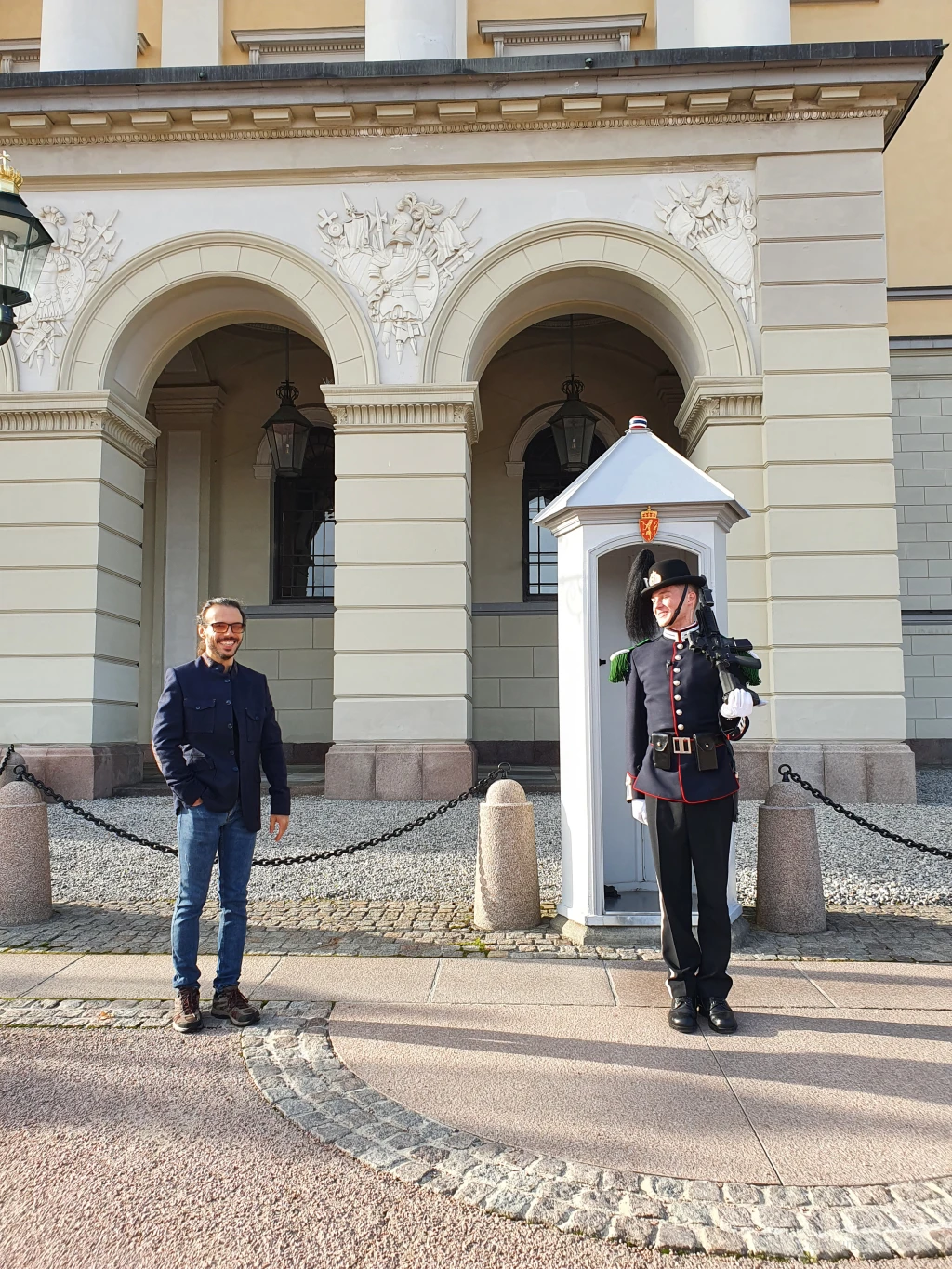
Behind the polished boots, dark blue uniforms, and military discipline are young people who are also part of Norwegian society. They are not simply figures standing outside a palace. They are participants in a living tradition, one that connects Norway's history, its monarchy, and its people.
And perhaps the best time to understand this relationship is May 17, Norway's Constitution Day.
A Guard with a History
His Majesty The King's Guard, known in Norwegian as Hans Majestet Kongens Garde, was established in 1856. Its original purpose was to strengthen the security surrounding King Oscar I in Stockholm, at a time when Norway and Sweden were joined in a union.
The unit later became the King's Guard and, as Norway moved towards independence, its role developed alongside the country's changing national identity.
The Guard's history is not limited to ceremonies and royal appearances. During the German invasion of Norway in April 1940, members of the unit fought at Midtskogen, helping to prevent German forces from capturing King Haakon VII and members of the Norwegian government.
This episode remains an important part of the Guard's history. It reminds us that the soldiers we see at ceremonial events also belong to a military organisation with real responsibilities in times of crisis and war.
Today, the Guard protects the Royal Family and royal residences, performs ceremonial duties, and contributes to the security of the Norwegian capital.
May 17: A Country Celebrates Together
To understand Norway, it helps to experience May 17.
On this day, the country celebrates the signing of its Constitution in 1814. Streets fill with Norwegian flags, marching bands, traditional clothing, music, and people of all ages. Families gather for breakfast, children enjoy ice cream, and communities come together to celebrate their country.
But what makes this national day particularly interesting is the central place given to children.
In many countries, national celebrations are dominated by displays of military power. Norway's Constitution Day has a different atmosphere. Children's parades are among its defining traditions, with schoolchildren marching through towns and cities, waving flags and celebrating alongside their communities.
In Oslo, the parade passes along Karl Johans gate towards the Royal Palace. Members of the Royal Family traditionally greet the children from the palace balcony.
The King's Guard also participates in the day's events. Its music and drill unit performs for the public, bringing together precision, rhythm, tradition, and spectacle.
There is something meaningful about seeing these carefully trained soldiers take part in a celebration where children, rather than military strength, occupy the centre of attention.
Children, Flags, and a Different Kind of Parade
The children's parade is more than a colourful procession. It reflects an idea of national identity that begins with participation.
Children are not merely spectators watching adults celebrate their country. They are active participants. They march with their schools, carry flags, sing, play instruments, and become part of a tradition passed from one generation to the next.
The Guard's presence adds another dimension to this scene. The soldiers represent duty and discipline, while the children represent the future. Their participation in the same national celebration brings these two ideas together.
It is a reminder that patriotism does not always need to be expressed through grand speeches or displays of force. Sometimes, it appears in a child's smile, a small Norwegian flag, or a marching band moving through a crowded street.
Soldiers Who Are Human, Too
One of the things that makes the King's Guard interesting to observe is the contrast between the seriousness of its duties and the more approachable side of its public presence.
A guard standing sentry outside a royal residence must follow strict rules. A soldier on duty cannot always stop to chat, smile freely, or respond to every passer-by. Their attention and behaviour are part of the responsibility they have been given.
Yet military discipline does not mean that a person is unfriendly.
When circumstances allow, public ceremonies and informal encounters can offer opportunities to exchange a few words, share a smile, or appreciate the lighter side of a formal uniform. The soldiers are people, often young people completing their military service, with personalities, humour, and lives beyond their duties.
There is no need to imagine them as aggressive figures simply because they wear military uniforms. Their role requires readiness and discipline, but that does not erase their human side.
And sometimes, the contrast is what makes the encounter memorable: a perfectly disciplined soldier, a relaxed smile, and a brief conversation that reminds you there is a person behind the uniform.
Of course, every soldier is an individual, and not everyone will respond in the same way. Respecting their duties and following their instructions is always important.
Tradition, Music, and Precision
The King's Guard is also known for its ceremonial music and drill performances. Its third company is particularly associated with musical performances and highly coordinated routines that attract audiences in Norway and abroad.
Watching a drill performance is an experience in itself. Every step, turn, and movement requires concentration and practice. What appears effortless to the audience is the result of preparation, repetition, and teamwork.
Yet these performances are not only demonstrations of military skill. They are also a form of public entertainment and a way of keeping a tradition alive.
On May 17, music and marching become part of the wider celebration. The sound of drums and brass instruments blends with children's voices, applause, and the waving of flags.
For a moment, a military tradition becomes part of a shared public experience.
A Small Penguin with a Remarkable Connection
The King's Guard also has an unusual and charming tradition: its association with a king penguin named Nils Olav at Edinburgh Zoo in Scotland.
The connection began in 1972, when members of the Norwegian Guard visited the Edinburgh Military Tattoo. Over the years, the penguin associated with the tradition received successive honorary military promotions. The current penguin in the tradition, Nils Olav III, was knighted in 2008 and promoted to brigadier in 2016.
It is a wonderfully unexpected detail in the history of a military unit. Alongside its serious duties, the Guard has a tradition that involves a penguin thousands of kilometres away.
The story offers a glimpse of how ceremony, humour, and affection can coexist with military formality.
Beyond the Uniform
The King's Guard represents an important part of Norway's royal and military traditions. Its history includes moments of conflict, its present-day duties require discipline, and its public appearances contribute to the country's ceremonial life.
But the most interesting way to understand the Guard may be to look beyond the uniform.
On May 17, the soldiers are part of a celebration that belongs to the whole community. Children march through the streets, families wave flags, musicians play, and the Royal Palace becomes a meeting point between the monarchy and the public.
The Guard stands within this picture not only as a symbol of authority, but also as a participant in a living national tradition.
Perhaps this is one of the most appealing things about Norway's Constitution Day: it offers a reminder that a country's identity is shaped not only by its institutions and history, but also by the people who celebrate it together.
And sometimes, if you are fortunate enough to meet a member of the Guard when their duties permit, a simple smile or a few friendly words can make the experience feel much more personal.
Behind the uniform, after all, there is a human being.
Sources and further reading
Share this post
Help others discover this content
Load Comments